Kashmir Sapphires Were And Will Always, Be Rarer Than Diamonds
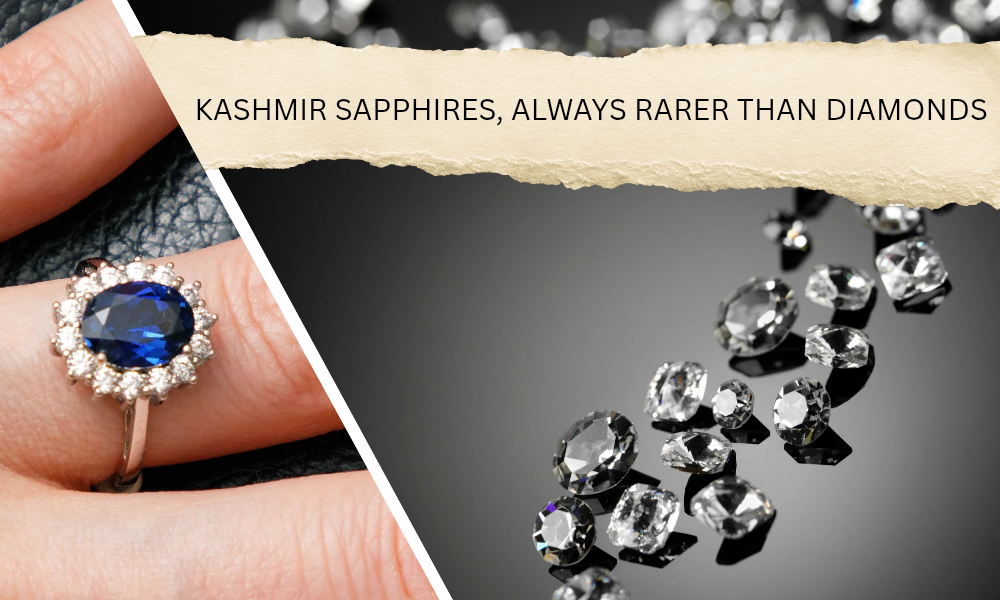
Kashmir sapphires occupy a near-mythic place in the world of gemstones: discovered in the late 19th century in high Himalayan deposits (the Paddar/Panjal area of the Kashmir region), they produced a small, extraordinary run of cornflower-to-royal blue stones with a distinctive, velvety “blue-velvet” appearance caused by very fine rutile (silk) inclusions. That visual quality—deep, evenly saturated blue with a soft, luminous texture—combined with the tiny, finite window of supply even at the time when, mining was at full peak, makes top-quality Kashmir sapphires exceptionally rare and highly prized by collectors and museums.
Historically the Kashmir sapphire finds were brief but spectacular. Most commercial production occurred in the 1880s and by the 1930s the easily mined pockets were largely exhausted; after that, genuinely new Kashmir material became vanishingly scarce. Because so few top-grade Kashmir crystals ever entered the market, the finest Kashmir stones today remain rarer on a per-carat basis than most gem-quality diamonds. This scarcity is a major reason why Kashmir examples consistently command auction records and collector premiums.
By contrast, diamond supply has expanded dramatically and geographically over the last century. While historically concentrated in India (Golconda mines), southern Africa, diamond mining has grown to include large, high-output operations in Russia, Botswana, Canada, Australia and parts of Central and West Africa. Modern exploration and industrial mining methods plus multiple major producing countries mean gem-grade and commercial diamonds are mined in far larger volumes today than the tiny, historical run of Kashmiri sapphire production—so in practical terms diamonds are much more commonly found in the modern retail and wholesale markets.
It should be mentioned that a few diamonds are still exceedingly rare. Fine-quality diamonds in large sizes—particularly the chemically pure Type IIa diamonds—are exceptionally scarce. These Type IIa diamonds are virtually nitrogen-free, giving them unmatched transparency and brilliance. Even so experts will agree that, the total number of fine Type IIa diamonds discovered globally still far exceeds the quantity of true, gem-grade Kashmir sapphires ever mined.
A few historic Kashmir blue sapphires illustrate the region’s pedigree and market power. Hill’s Kashmir (an unnamed 22.66-carat cushion sapphire, long associated with James J. Hill) set auction records and is widely cited as one of the finest Kashmir stones seen in modern times. The so-called “Rockefeller Kashmir” (a notable cabochon in the Rockefeller collection that has recently been consigned to major auctions) and examples described in Christie’s and Sotheby’s sales catalogs (often labeled with provenance like “Kashmir, late 19th century”) are further examples of the stones that stir the market; when these appear at auction they reliably draw very high estimates and deep collector interest.
Sporadic reports in recent times report the sighting of the Zanskar Crown Sapphire. The large cushion cut Kashmir blue sapphire with a weight that is estimated to be 170+ carats, has apparently been located in a European collection. Besides being of a very high quality, this Kashmir sapphire is believed to have belonged to the Maharajas of Kashmir until the early 1920s. That was when Maharaja Pratap Singh, sold the Zanskar Crown to generate funds for the development of the Kashmir region. If the narrative revealed so far is true, the Zanskar Crown sapphire – would dethrone the 150.13 carat The Spirit Of Kashmir Sapphire, which currently holds the record for being the largest Kashmir sapphire.
What this means for gem buyers, curators and anyone tracking rarity: Kashmir sapphires are not merely “expensive sapphires” — they are a historically limited, region-specific phenomenon whose best examples are effectively finite. Diamonds, while culturally framed as the archetypal precious gemstone, exist today in a far wider production base and in much greater total volume. Collectors who prize provenance, historic mines and that singular Kashmir “velvet” look will continue to prize Kashmir stones above and beyond the general diamond market—both for aesthetic reasons and for the immutable economics of extreme scarcity.